The Compounding Interest of Small Wins: A Mindset Realization
- Matthew Elizondo

- Mar 25
- 6 min read
I used to spend a lot of time waiting for the "big break." You know the one: the viral post that changes your career overnight, the massive client that pays for a whole year’s expenses in one go, or the sudden stroke of creative genius that puts your name on the map. We’re conditioned to love the "overnight success" story because it feels like a lottery ticket we might actually win.
But recently, as I sat in my home office looking over some financial spreadsheets and a few ongoing media design projects, I had a realization. Success isn't a lottery. It’s a bank account.
The most powerful force in the universe isn't a single explosion of effort; it’s compounding interest. And it doesn't just apply to money. It applies to your habits, your skills, your discipline, and even the way you show up for your family.
The Linear Trap
Most of us think linearly. We assume that if we put in two units of effort, we should get two units of results. If we work twice as hard tomorrow, we should see twice the progress. When that doesn't happen: when we work hard and the needle barely moves: we get frustrated. We think the system is broken, or worse, that we are.
This is the linear trap. We expect a straight line pointing toward the sky. But real growth, the kind that actually sticks, follows an exponential curve.
In the beginning, the curve is so flat it looks like a horizontal line. You’re putting in the work, you’re making the "small wins," but the results are invisible. This is where most people quit. They don’t realize they are actually building the foundation for an inflection point that is just a few months or years away.
The Financial Parallel: It’s Not About the Amount
I’ve spent a lot of time mastering financial literacy, and the biggest lesson I’ve learned is that the habit of saving is more important than the amount saved.
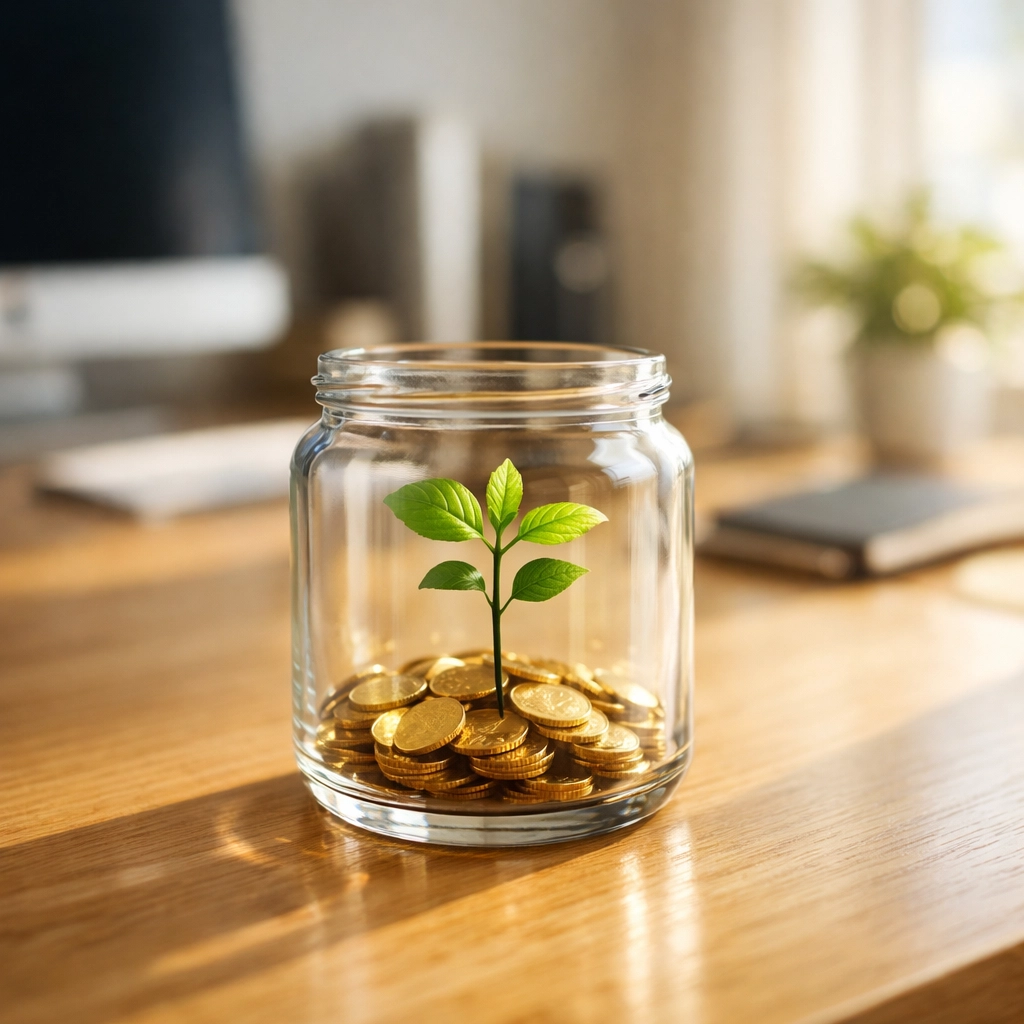
If you save $10 a week, it feels insignificant. It’s the price of a couple of coffees. Over a month, it’s $40. At the end of a year, it’s $520. Still, in the grand scheme of things, $520 doesn't feel like it’s changing your life.
But if you keep that up for five years, adding a modest interest rate, that "insignificant" habit turns into thousands of dollars. More importantly, it builds the identity of someone who saves. When you eventually have the capacity to save $100 or $1,000 a week, the discipline is already there. The interest compounds on the money, but the discipline compounds on your character.
Creativity and the 1% Rule
As a freelancer and entrepreneur, I see this same principle at play in graphic design. When I first started, I wanted every project to be a masterpiece. I wanted to reinvent the wheel every time I opened a new file in Illustrator.
I quickly realized that’s a recipe for burnout.
Instead, I started focusing on the 1% rule: just get 1% better with every project. Maybe today I learn a new shortcut for masking. Maybe tomorrow I figure out a better way to handle typography for a specific brand tone. Individually, these are small wins. They don’t feel like "game changers."
But after 100 projects, I’m not just 100% better: I’m exponentially better because each new skill interacts with the ones I already have. My AI-powered financial tools projects didn't happen because I woke up one day as an expert; they happened because I spent years stacking small realizations about design and data on top of each other.
The Invisible Inflection Point
The hardest part of this mindset realization is the "Plateau of Latent Potential." This is a term often used to describe the period where you are doing the work but not seeing the reward.
Imagine an ice cube sitting in a room that is 25 degrees. You heat it up one degree at a time. 26 degrees... nothing. 27 degrees... nothing. 30 degrees... still nothing. 31 degrees... nothing.
Then, you hit 32 degrees. Suddenly, the ice begins to melt. A one-degree shift, no different from the ones before it, has unlocked a massive physical change.
In business and in life, we are often at 31 degrees. We are doing the work, making the small wins, but we haven't hit the melting point yet. This is where unlocking wealth strategies becomes more about psychology than math. You have to trust that the interest is compounding even when you can't see the balance.

Fatherhood and the Long Game
I see this most clearly with my kids. As they’ve grown into teenagers, the nature of our relationship has changed, but the "compounding" hasn't stopped.
When they were younger, you could see the growth every day. Now, with teenagers, the "wins" are much subtler. It’s a 10-minute conversation in the car. It’s a quick text to check-in. It’s showing up to their events, even when I’m busy with work.
None of these individual moments feel like "Parent of the Year" material. But over a decade, these small, consistent deposits of time and attention build a foundation of trust. You can't "cram" a relationship. You can't ignore your kids for six months and then try to make up for it with a massive two-week vacation. The interest doesn't work that way. It requires daily, small wins.
Discipline as a Skill, Not a Trait
People often tell me, "I wish I had your discipline." But discipline isn't something you're born with; it’s a skill that compounds.
Every time you choose to sit down and work on your AI strategy instead of scrolling through social media, you are making a deposit. Every time you choose to stick to your budget, you are making a deposit.
At first, it’s hard. It takes a lot of mental energy to make the "right" choice. But as the wins compound, the "right" choice becomes the "easy" choice. The habit takes over, and suddenly, you aren't "using discipline": you are simply being who you are.

Why We Struggle with Small Wins
We struggle because our culture is obsessed with the finish line, not the track. We celebrate the exit, the launch, and the trophy. We don't celebrate the Tuesday morning workout or the Friday afternoon bookkeeping.
To realize the power of compounding, you have to fall in love with the process. You have to find a way to get a hit of dopamine from the act of doing the work, rather than the result of the work.
When I’m working on innovative design meet financial strategy concepts, I try to focus on the clarity of the layout in that moment, not how many likes the post will get later. If the layout is clean, that’s a win. If the message is simple, that’s a win.
How to Start Compounding Today
If you're feeling stuck, or like you're working hard but going nowhere, try shifting your focus to these three areas:
Lower the Bar for a "Win": Don't aim to write a whole book; aim to write one paragraph. Don't aim to save $10,000; aim to save $10. The goal is to keep the streak alive.
Audit Your Deposits: Are you making daily deposits into your skills, your health, and your bank account? Or are you making withdrawals by choosing instant gratification over long-term growth?
Be Patient with the Curve: Remember the ice cube. Just because it isn't melting yet doesn't mean the heat isn't working.
The Realization
The biggest realization for me was that the "big break" is actually a myth. What looks like a big break to an outsider is usually just the moment someone’s compounding interest finally became visible to the world.
Success is boring. It’s consistent. It’s the result of small, seemingly insignificant wins that most people are too impatient to collect.
I’m choosing to collect them. I’m choosing to show up, do the work, save the money, and be present for my family. It might not look like much today, but I know where the curve is headed.
If you’re looking to start your own journey of compounding: whether that’s through better financial advisory or elevating your brand’s visual identity: remember that the best time to start was yesterday. The second best time is right now.
Let's get those small wins today. The interest is waiting.

Comments